
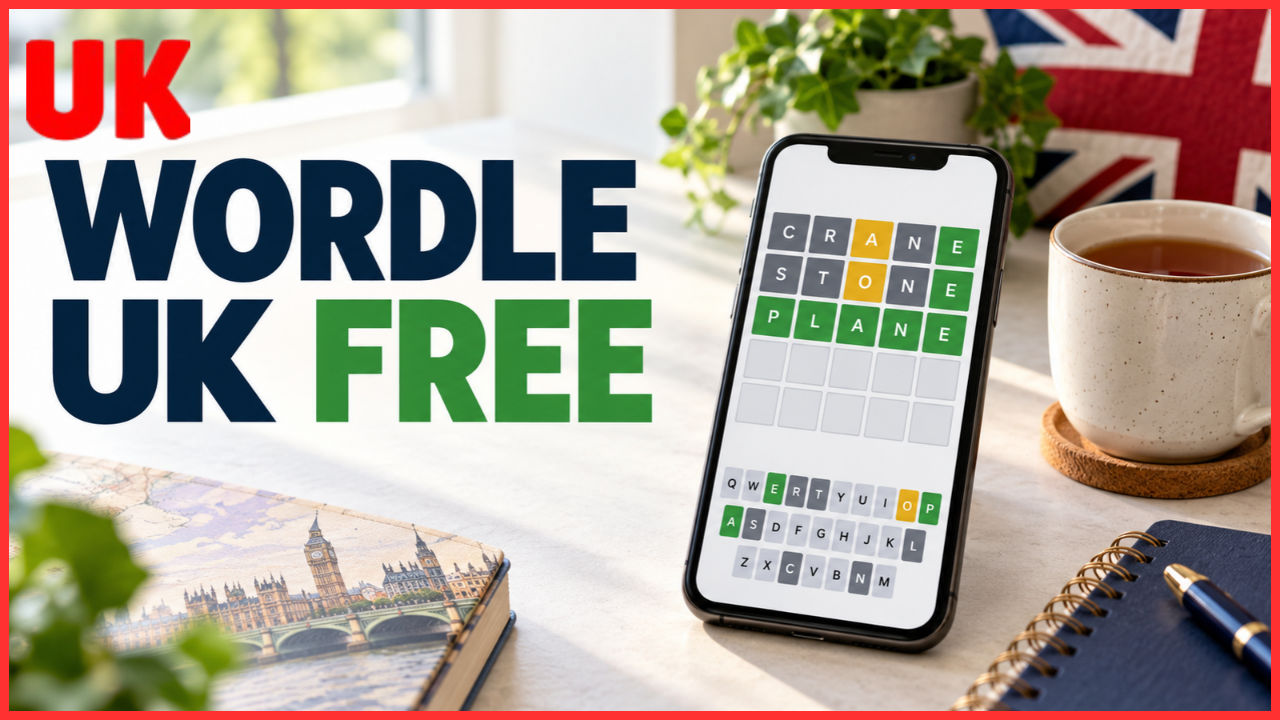
Searching for Wordle UK free but unsure which game to open or whether you need a subscription? The official daily Wordle is free to play, while independent UK versions offer their own puzzles and features.
Here is how to choose the right version, understand the coloured clues and make more thoughtful guesses—without spoiling today’s answer.
Can You Play Wordle UK Free?
Yes. The New York Times lists its daily Wordle among the games available without a paid subscription. Its subscription service includes additional features, with full access to analysis tools such as Wordle Bot reserved for eligible subscribers.
There are also independent websites advertising free British English word puzzles. These are separate games, so their answers, dictionaries and settings may differ from the official Wordle.
The important distinction is what you want to play: the official daily puzzle, a game using British spellings, or unlimited practice rounds.
Official Wordle or an Independent UK Version?
The official Wordle is available through . Its app listing identifies it as the game created by Josh Wardle, with a five-letter answer and six attempts.
Independent UK versions may use British English dictionaries. For example, Wordle-Unlimited.io describes its UK edition as a British English game offering unlimited rounds. That is the provider’s description of its own version, rather than a rule shared by every Wordle-style website.
How to Play: A Simple Step-by-Step Guide
The aim is to identify the hidden word by combining information from successive guesses.
- Open your chosen game. Check whether you are playing the official daily puzzle or an independent version.
- Read the instructions. Confirm the word length, attempt limit and language setting.
- Enter your first word. Choose a valid word that tests several different letters.
- Study the feedback. Each coloured tile tells you something about the answer.
- Build your next guess around the clues. Keep confirmed positions and reconsider letters that belong elsewhere.
- Review the result. Whether you solve it or run out of attempts, identify the clue that mattered most.
You do not need to guess quickly. Taking a moment between rows helps you avoid submitting a word that earlier clues have already ruled out.
Understanding the Tile Colours
The standard Wordle colour system works like this:
| Tile colour | Meaning | Your next step |
|---|---|---|
| Green | Correct letter, correct position | Keep that letter in place |
| Yellow | Correct letter, wrong position | Try it somewhere else |
| Grey | That occurrence does not receive a match | Consider other letters and check for duplicates |
The New York Times describes green, yellow and grey using these core meanings in its game guidance. The wording around grey tiles matters when you repeat a letter. If one E is green and another E is grey, the grey tile does not mean the answer contains no E. It can mean you have guessed more copies than the answer contains.
Does a UK Version Use British Spellings?
Some do, but check the individual game’s instructions.
British and American spellings can change the order of letters even when both versions fit a five-letter grid. FIBRE and FIBER, for example, share the same letters but place the final two differently.
Other useful pairs include:
- LITRE and LITER
- METRE and METER
A British English label does not guarantee that every regional word, slang term or spelling variation will be accepted. Independent providers choose their own word lists; one UK version advertises British English specifically, while another says it includes both UK and US vocabulary.
Also, acceptance as a guess does not necessarily mean a word belongs to the game’s possible answer list.
Practical Ways to Improve Your Guesses
A useful strategy should adapt as the board fills up. Your opening word gathers information; later guesses need to make sense of it.
Start With Several Different Letters
An opening word such as CRANE, SLATE or ROUND tests five distinct letters.
These are practical examples, not guaranteed winning choices. A familiar word can be a useful opener if it helps you interpret the feedback confidently.
Avoid using a fixed second guess regardless of what happens. If your opening row reveals several letters, use them.
Combine Clues Across Every Row
Imagine a practice puzzle whose answer is CROWN.
You begin with CRANE:
- C and R turn green.
- N turns yellow.
- A and E turn grey.
You now know that the word starts with CR, contains N somewhere other than the fourth position, and excludes A and E.
CROWN fits all those clues. You may still have other possibilities to consider, but you have a reason for choosing it.
This is more effective than selecting another familiar word simply because it comes to mind.
Remember That Letters Can Repeat
Once several letters are confirmed, consider whether the answer needs a repeated letter.
Words such as SHEEP, APPLE and LEVEL illustrate the possibilities. Avoid treating every remaining space as though it must contain a new letter.
Equally, do not force a double when the feedback excludes it. Count the positive matches carefully.
Check Your Guess Before Pressing Enter
Give each proposed word a quick review:
- Have you preserved the green positions?
- Have you moved yellow letters away from excluded positions?
- Are you repeating a grey letter without a reason?
- Does the spelling match the selected dictionary?
This small habit makes practice more useful because it reduces mistakes you already had enough information to avoid.
Daily Puzzles or Unlimited Practice?
Choose daily play if you enjoy having one puzzle to return to regularly. Choose an unlimited version if you want to practise different opening words or work on a particular weakness.
Some independent UK games explicitly offer unlimited rounds, but their results belong to those games. Do not assume their answers or records match the official Wordle.
For focused practice, play a few rounds with one goal: spotting repeated letters, tracking yellow positions or checking spelling. Reviewing a mistake can teach you more than immediately starting another puzzle.
Frequently Asked Questions
Is the official Wordle free in the UK?
Yes. The New York Times identifies daily Wordle as available without a paid Games subscription. Additional tools and subscription features have separate access requirements.
Do I need to download an app?
You can play through a web browser. The New York Times also offers its Games app for supported mobile devices, so downloading an app is an alternative rather than the only route.
Can I play more than one puzzle a day?
The official game follows a daily format. For repeated practice, independent unlimited versions offer additional rounds; check the provider’s rules and dictionary.
Why is my British spelling rejected?
The selected dictionary may use another spelling or exclude that particular word. Check the language setting and the game’s help page before assuming the word is misspelt.
What is the best starting word?
There is no opening word that guarantees a solution. Start with a valid word containing several different letters, then let the feedback guide your next choice.
Make Your Next Puzzle Count
Finding Wordle UK free starts with choosing the experience you want: the official daily challenge or an independent British English puzzle. Check the rules, pay attention to spelling and use every previous row when making your next guess.
Open your chosen game and try one simple improvement today: pause before submitting, then check your word against every clue.
Read more : Ukwordle.co.uk