
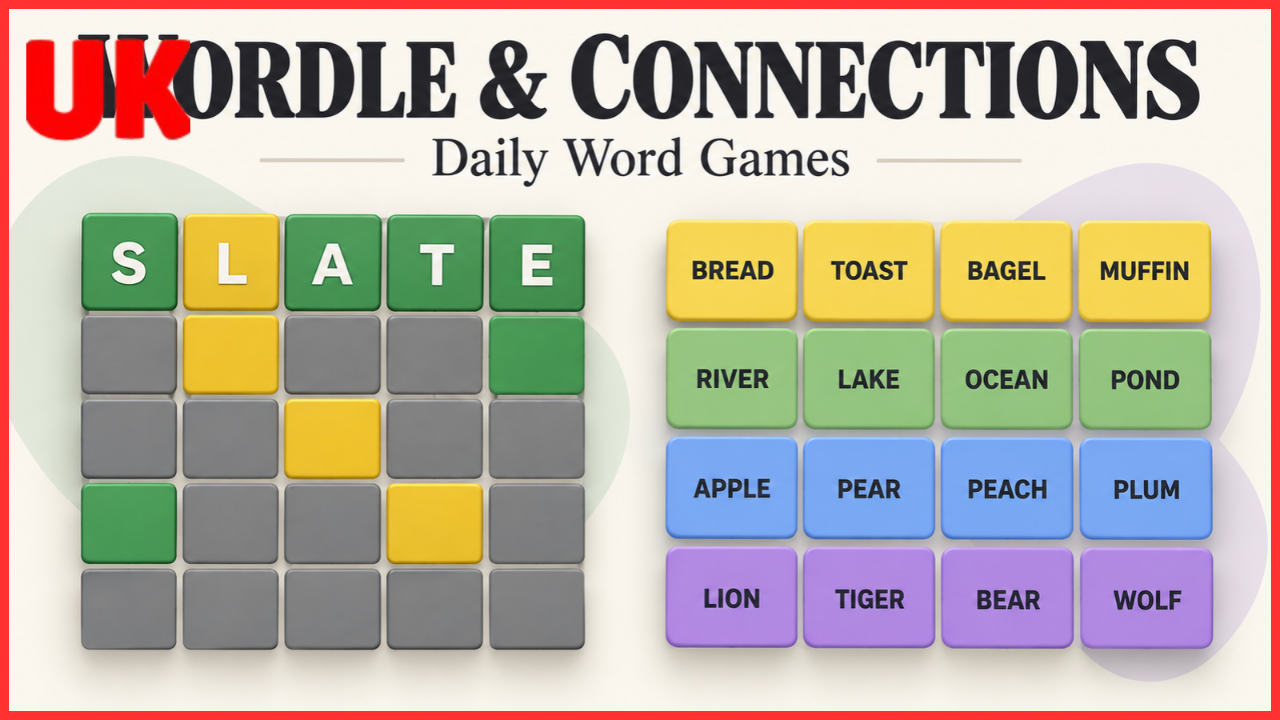
Searching for “wordle connections” and wondering whether it is one game or two? Wordle and Connections are separate New York Times puzzles: one asks you to discover a hidden word, while the other challenges you to find relationships between words.
This guide explains their differences, shows how to approach each puzzle and offers practical examples you can use without revealing today’s answers.
Wordle Connections: What Is the Difference?
Both games involve words, but they reward different approaches. Wordle centres on spelling and elimination. Connections asks you to recognise shared meanings, expressions and other links.
| Feature | Wordle | Connections |
|---|---|---|
| Main objective | Find one five-letter word | Identify four groups of four related items |
| Starting information | An empty guessing grid | A board containing 16 items |
| Feedback | Coloured tiles after each guess | Correct groups are revealed; incorrect submissions cost mistakes |
| Limit | Six guesses | The fourth mistake ends the game |
| Main challenge | Narrowing down letters and positions | Separating intended categories from plausible overlaps |
Wordle’s six-attempt format and Connections’ grouping rules make them distinct experiences, even though both belong to the NYT Games collection.
How to Play Wordle
Start by entering a valid five-letter word. After you submit it, the tiles change colour to show how your guess relates to the answer.
In the standard colour scheme:
- Green: The letter is correct and in the correct position.
- Yellow: The letter appears in the answer, but elsewhere.
- Grey: That occurrence of the letter is not needed in the answer.
The last distinction matters when guessing repeated letters. One copy can receive a coloured tile while an extra copy turns grey.
A simple Wordle example
Imagine the answer is PLANT and your opening guess is SLATE. This is an illustrative example, not today’s solution.
The L and A would turn green because their positions match. T would turn yellow because it belongs at the end. S and E would turn grey.
Your next step is to look for words that preserve those confirmed positions and place T somewhere other than fourth. You are building on evidence rather than starting again.
Choose guesses that answer a question
A useful opening word tests several different letters. SLATE and CRANE, for example, each contain five distinct letters, making them reasonable starting options without guaranteeing success.
After that, adapt. If your first guess produces little information, consider a word that tests unused letters. If it reveals several useful clues, look for answers that fit them.
Before submitting, ask: “What will this guess help me learn?” That question can prevent a rushed attempt that simply repeats information you already have.
How to Play Connections
Connections begins with 16 items. Select four that share a specific connection, then submit the group. Continue identifying sets until the board is complete.
The categories have an intended difficulty order: yellow, green, blue and purple, progressing from the most straightforward to the trickiest. However, a category that feels obvious to one player may puzzle another. The NYT explains that each board has one intended solution, with overlapping possibilities deliberately creating difficulty.
Start with a precise category
Consider this original practice group:
VIOLIN — CELLO — HARP — GUITAR
“String instruments” describes all four clearly. “Things associated with music” also fits, but it is much broader and therefore less useful when checking competing possibilities.
Try naming your proposed category before submitting. If the explanation needs several exceptions, reconsider the group.
Look beyond dictionary meanings
Some connections depend on how words combine rather than what they mean individually.
For example:
COAT — DROP — BOW — FOREST
Each can follow RAIN, producing raincoat, raindrop, rainbow and rainforest. This is another practice example, not a daily puzzle answer.
When a board seems disconnected, test whether several words can follow the same word, precede it or participate in a familiar phrase.
A Step-by-Step Connections Strategy
A consistent routine can help you avoid spending mistakes on your first impression.
- Read every item. Do not submit the first four related words before checking the rest.
- Form a tentative category. Give the relationship a short, specific name.
- Look for extra candidates. If five words fit, investigate which one may belong elsewhere.
- Check alternative meanings. A word such as “pitch” can refer to sound, a playing field or a sales presentation.
- Submit your strongest group. Then reassess the smaller board with fresh attention.
For example, BASS might suggest a fish or a musical register. If you automatically choose the musical meaning, you may overlook a stronger category.
The useful habit is flexibility: treat your first interpretation as a possibility, not a commitment.
Common Mistakes That Make Both Games Harder
Forgetting repeated letters in Wordle
A five-letter answer does not need five different letters. Once you have tested several possibilities, consider whether a known letter could appear again.
Do not rule out a word merely because it repeats a letter. Read the feedback for each occurrence carefully.
Accepting a loose Connections category
Four words can share an association without forming the intended group. “Things found outside” is usually a weaker explanation than a clearly defined category such as “types of cloud.”
Check whether your proposed link applies equally to all four words and whether another item fits just as well.
Using hints too aggressively
If you want help while preserving the challenge, reveal information gradually. For Wordle, try a meaning clue before viewing the answer. For Connections, try a broad category hint before revealing its members.
Also check the puzzle date. An accurate hint for yesterday’s game will not help with today’s board.
Where to Play the Official Games
Open Wordle or Connections through The New York Times website. These links lead to separate games.
The Connections Help Center also lists the NYT Games app as an official option. Its standard daily puzzle is free, while access to the Connections archive requires an eligible subscription.
Frequently Asked Questions
Is Wordle Connections one game?
No. The phrase brings together the names of two separate NYT word games. Their objectives and solving methods differ.
Which is harder: Wordle or Connections?
It depends on your strengths and the puzzle. Wordle emphasises letter deduction, while Connections requires flexible thinking about meanings and associations.
How many mistakes can you make in Connections?
The fourth incorrect submission ends the game. You need to complete the board with fewer than four mistakes to win.
Can Wordle answers contain repeated letters?
Yes. Repeated letters are possible, and each occurrence receives its own feedback. A grey duplicate does not necessarily mean the letter is entirely absent.
Should beginners use hints?
Hints can help you understand an unfamiliar word or category. Start with the smallest clue available, then return to the puzzle before revealing more.
Conclusion
The main lesson from this Wordle Connections guide is to match your strategy to the game. In Wordle, use each guess to narrow the letter possibilities. In Connections, test specific relationships and question words that could belong to several groups.
Try one official puzzle now. Before each submission, explain your reasoning in a sentence—you may spot a weak guess before it costs you an attempt.
Read more : Ukwordle.co.uk