
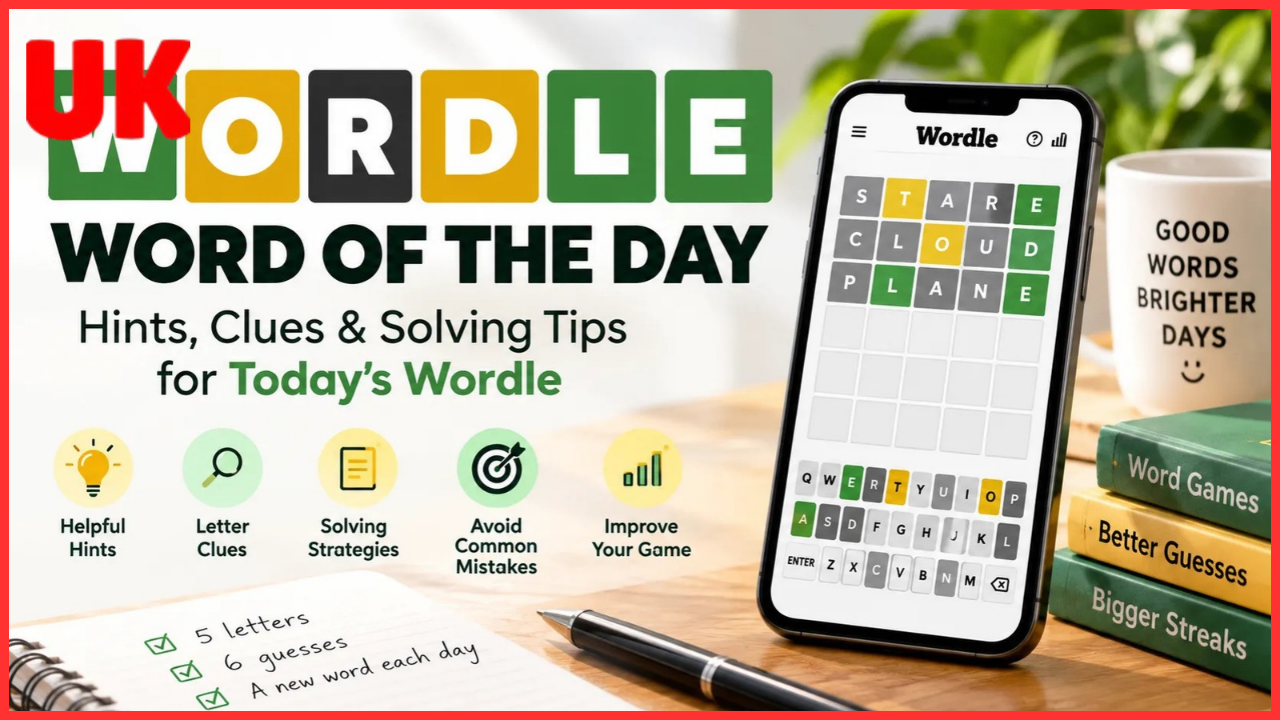
A useful Wordle clue should help you move forward while leaving the final discovery to you. If your board looks confusing or several words seem possible, this guide explains how to interpret the hints, narrow your options and make a more purposeful next guess.
The examples below are practice scenarios, so you can follow them without revealing today’s answer.
What Counts as a Wordle Clue?
Wordle gives you six attempts to identify a five-letter word. After each accepted guess, coloured tiles reveal information about the letters and their positions. These tiles provide the clues you need to solve the puzzle.
An additional Wordle hint might describe the answer’s meaning, reveal its first letter or tell you whether a letter repeats. Each offers a different level of help.
Before looking for an outside hint, review your existing board. A yellow letter you have forgotten to move or a duplicate letter you have overlooked may already explain why you feel stuck.
Choose How Much Help You Want
Start with the least revealing clue that could help:
- A broad meaning hint: points towards a category or idea.
- A repeated-letter hint: helps you reconsider the word’s structure.
- A starting-letter clue: sharply reduces the possibilities.
- A partial spelling: useful when you are close to running out of attempts.
- The answer: ends the puzzle rather than helping you solve it.
There is no need to reveal everything at once. Read one hint, return to the board and see whether it changes your thinking.
How to Read Wordle’s Tile Colours
Understanding the feedback matters more than memorising a list of starting words.
| Tile colour | Meaning | What to do next |
|---|---|---|
| Green | The letter is correct and in the right position. | Keep that position when considering possible answers. |
| Yellow | The letter appears in the answer, but elsewhere. | Try it in another available position. |
| Grey | That copy of the letter is not needed in the answer. | Check for other coloured copies before ruling the letter out completely. |
Repeated letters require particular care. When a guess contains the same letter twice, one copy can receive a coloured tile while the other turns grey.
A Yellow Letter Gives Two Pieces of Information
A yellow tile confirms that a letter belongs in the word. It also rules out the position where you just placed it.
For example, if A turns yellow in the second position, a candidate with A only in that position cannot be the answer. Simply remembering “the word contains A” loses half the clue.
A Wordle Clue Worked Example
Imagine a practice puzzle whose answer is PLANT, and your opening guess is SLATE.
The feedback would be:
| Position | Guessed letter | Feedback |
|---|---|---|
| First | S | Grey |
| Second | L | Green |
| Third | A | Green |
| Fourth | T | Yellow |
| Fifth | E | Grey |
You now know that L and A belong in the second and third positions. T is present, but it cannot occupy the fourth position. S and E are absent.
A candidate such as PLATE conflicts with that evidence: it puts T in the rejected position and includes E. PLANT, however, fits every clue.
The lesson is to check the whole word against the board. A familiar word that matches two green tiles can still be impossible.
How to Use a Wordle Clue Step by Step
1. Record the Confirmed Positions
Write down your green letters with their positions, such as “second letter L, third letter A”.
This gives you a clear reference when several guesses start to blur together.
2. Track Yellow Letters Separately
List each yellow letter and the positions where it has already failed.
If R has appeared yellow in both the first and fourth positions, test candidates that place it elsewhere.
3. Review the Grey Letters
Remove candidates containing letters that have been ruled out. Before excluding a repeated letter, inspect every copy in the same guess.
That extra check prevents you from discarding a valid candidate because one duplicate tile was grey.
4. Build a Short Candidate List
Think of words that satisfy all the evidence. Check each candidate for:
- Correct green positions.
- Inclusion of yellow letters.
- Avoidance of rejected yellow positions.
- Consistency with duplicate-letter feedback.
5. Choose a Guess With a Purpose
Ask what the next guess could teach you. Will it distinguish between your remaining candidates, test an uncertain vowel or check whether a letter repeats?
A guess is more useful when you can explain why you are making it.
Why Repeated Letters Can Be Misleading
Consider another practice example: the answer is APPLE, and you guess ALLEY.
A would turn green. One L would turn yellow, while the other L would be grey. E would also turn yellow, and Y would be grey.
The grey L does not mean there is no L in the answer. Together, the two L tiles indicate that the answer contains one L rather than two. Duplicate feedback limits how many copies of a letter can appear.
Do not assume every answer has five different letters. When the available single-letter combinations stop making sense, reconsider doubles.
Choosing a Useful Starting Word
An opening word with five different letters lets you test five distinct possibilities. Words such as SLATE, CRANE and TRACE illustrate that approach.
These are examples, not guaranteed winning choices. Your next guess should respond to the feedback rather than follow a fixed routine regardless of what happens.
If your opener reveals several useful letters, develop those clues. If it reveals very little, testing a different mix of letters may give you more information.
Common Mistakes That Waste Guesses
One mistake is guessing variations too quickly. If several words share the same ending, repeatedly changing one letter may consume your remaining attempts without resolving the uncertainty efficiently.
Another is following a meaning hint while ignoring the board. Even a convincing definition cannot make a word fit a rejected letter position.
Finally, check the date and puzzle number before using a page labelled “today’s Wordle hint”. A clue for another puzzle can send an otherwise sound solution in the wrong direction.
Frequently Asked Questions
What is the best Wordle clue to read first?
Start with a broad meaning hint or a repeated-letter clue. These can help you rethink the answer without immediately revealing its spelling.
Can Wordle contain repeated letters?
Yes. Judge each copy using the complete row of feedback; a grey duplicate does not necessarily eliminate the letter.
What does a yellow tile mean?
The letter appears in the answer, but the position you guessed is wrong. Move it when considering your next candidate.
Should every guess be a possible answer?
Not necessarily. In normal mode, an accepted word can help test letters even if it cannot be the solution. Hard Mode requires you to retain revealed green positions and include revealed yellow letters.
Can a clue guarantee that I will solve Wordle?
No. A clue narrows the possibilities, but you still need to combine it with your existing feedback and remaining attempts.
Conclusion
The most useful Wordle clue is often already on your board. Read every tile carefully, track yellow positions and account for repeated letters before reaching for another hint.
Before submitting your next guess, check it against all the evidence. If you still need help, reveal one small clue and give yourself another chance to find the answer.
Read more : Ukwordle.co.uk