
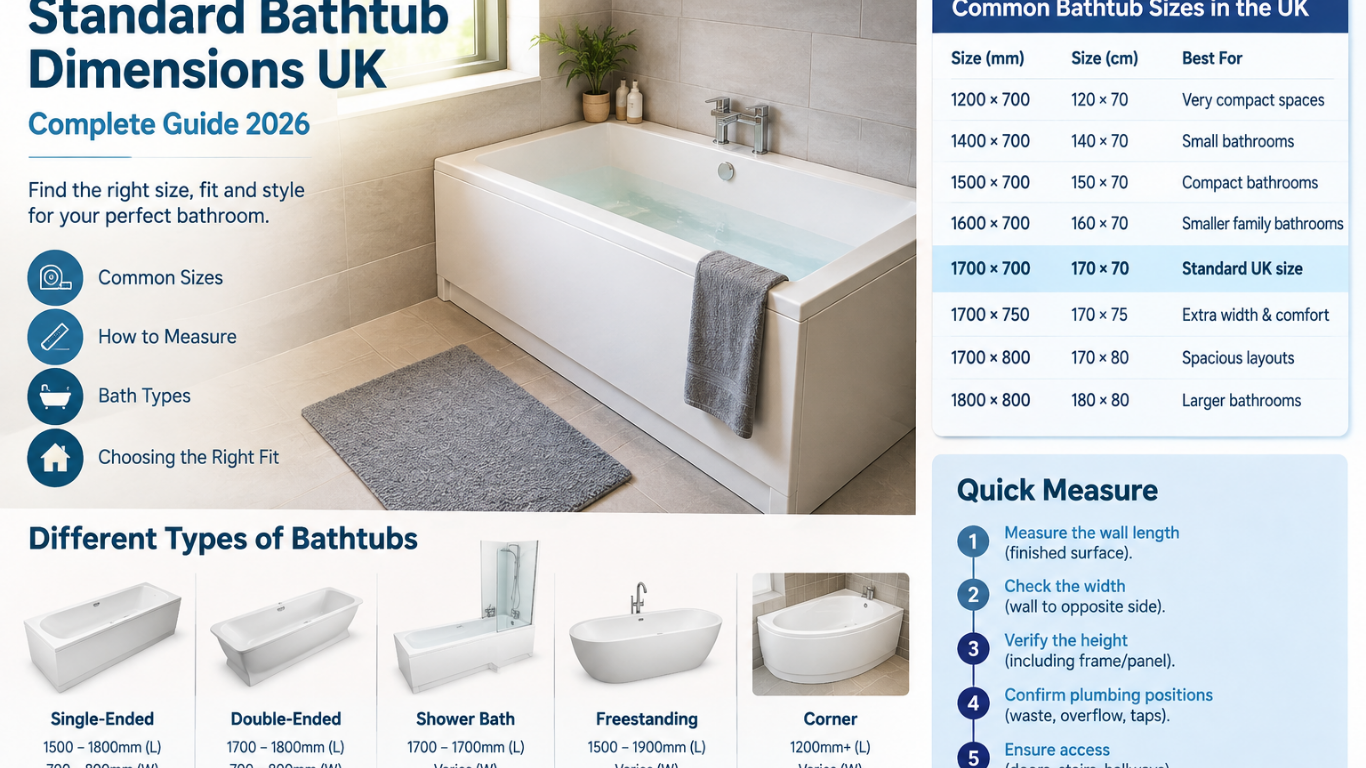
Choosing the right bathtub is an important part of designing or renovating a UK bathroom. A bath needs to be comfortable to use, but it also needs to fit correctly within the available space. Understanding standard bathtub dimensions UK can make it much easier to compare different models and choose a suitable size for your bathroom.
In the UK, 1700mm × 700mm is one of the most common standard bath sizes. However, it is not the only option. Baths are available in shorter 1200mm, 1400mm, 1500mm and 1600mm lengths, while larger models can measure 1800mm or more. Common widths include 700mm, 750mm and 800mm, depending on the style and design.
This 2026 guide explains standard bathtub sizes in the UK, how to measure for a new bath, the differences between bath types, and how to choose the right dimensions for your bathroom.
Quick Guide: Standard Bathtub Dimensions UK
| Bath Size | Approx. Size in CM | Best Suited For |
|---|---|---|
| 1200 × 700mm | 120 × 70cm | Very compact spaces |
| 1400 × 700mm | 140 × 70cm | Small bathrooms |
| 1500 × 700mm | 150 × 70cm | Compact bathrooms |
| 1600 × 700mm | 160 × 70cm | Smaller family bathrooms |
| 1700 × 700mm | 170 × 70cm | Common standard UK size |
| 1700 × 750mm | 170 × 75cm | Extra width and comfort |
| 1700 × 800mm | 170 × 80cm | Spacious shower/bath layouts |
| 1800 × 800mm | 180 × 80cm | Larger bathrooms |
These are commonly available sizes rather than a single legally required bathtub dimension. Exact dimensions can vary between manufacturers and individual models.
What Is the Standard Bathtub Size in the UK?
The most commonly recognised standard bathtub dimension in the UK is 1700mm long × 700mm wide, or 170cm × 70cm.
This size works well in many UK bathrooms because it provides a useful amount of bathing space without requiring an unusually large room. Current UK bathroom ranges also show many 1700 × 700mm models across single-ended and double-ended designs.
However, the word “standard” should not be interpreted as meaning every UK bath has exactly the same measurements. Different manufacturers produce baths in a range of lengths, widths, heights and internal shapes.
For example, 1700 × 750mm and 1700 × 800mm models are also widely available. A wider bath can provide a more spacious feel, but it requires more floor area.
Standard Bathtub Dimensions in MM and CM
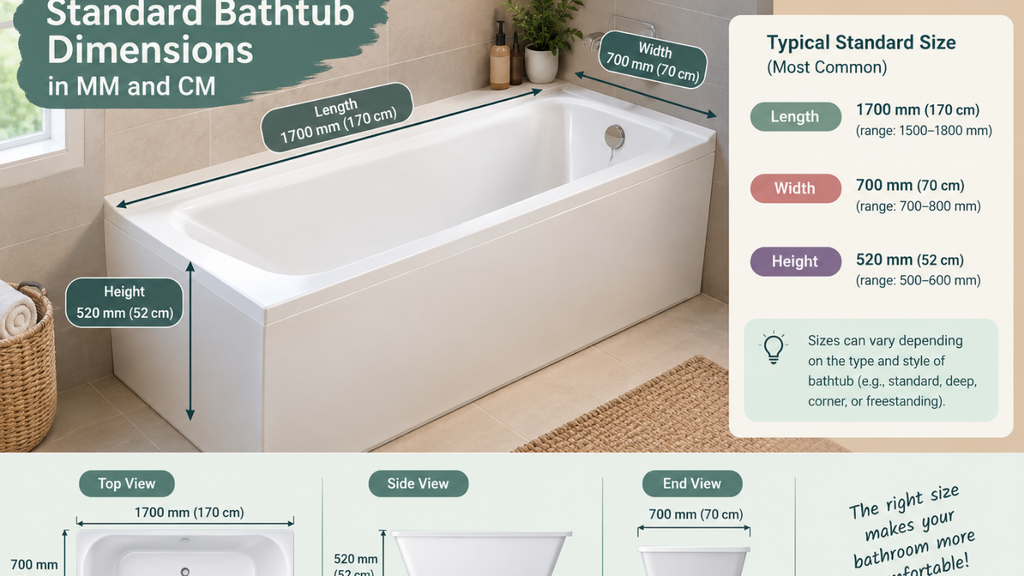
Most UK bathroom suppliers use millimetres when listing bath dimensions. Understanding the measurements makes comparing different products much easier.
1500 × 700mm Bath
A 1500mm × 700mm bath measures 150cm × 70cm. It is shorter than the common 1700mm model and can be useful when wall space is limited.
1600 × 700mm Bath
A 1600mm × 700mm bath provides a middle option between compact and standard sizes. It can work well where a 1700mm bath is slightly too long.
1700 × 700mm Bath
This is the classic standard-size reference for many UK bathrooms. It measures 170cm long and 70cm wide and is available in a large variety of designs.
1700 × 750mm Bath
Increasing the width from 700mm to 750mm gives an additional 50mm of width. This can make the bath feel more spacious without increasing its length.
1800 × 800mm Bath
An 1800 × 800mm bath is considerably larger and is generally better suited to bathrooms with additional floor space. Current UK ranges include 1800 × 800mm straight baths.
Quick Measure: How to Measure for a Bathtub
Measuring your bathroom correctly before buying a bath is one of the most important steps.
Step 1: Measure the Available Length
Measure the wall or opening where the bathtub will be installed. Take the measurement from the finished surfaces rather than relying on the original room dimensions.
For example, if your available length is approximately 1720mm, a 1700mm bath may be suitable, provided the manufacturer’s installation requirements allow enough tolerance.
Step 2: Measure the Available Width
Measure from the wall to the opposite edge of the proposed bath area.
A standard 700mm-wide bath may work well in a compact room. If you choose a 750mm or 800mm model, make sure the extra width does not interfere with the toilet, basin, shower area or bathroom door.
Step 3: Check the Bath Height
Do not look only at length and width. Check the manufacturer’s overall height as well.
For example, current bath ranges include models around 510–540mm high, while the finished installed height can vary according to the frame, legs, flooring and installation method.
Step 4: Check the Plumbing
Before purchasing a replacement bath, check the existing waste, overflow and tap arrangement.
A bath with different plumbing positions may require additional installation work.
Step 5: Measure the Access Route
The bath must also be capable of entering your property.
Measure doorways, hallways, stairways and bathroom entrances where necessary. A bathtub that fits the bathroom perfectly is not useful if it cannot be brought into the room.
How Deep Is a Standard Bathtub?
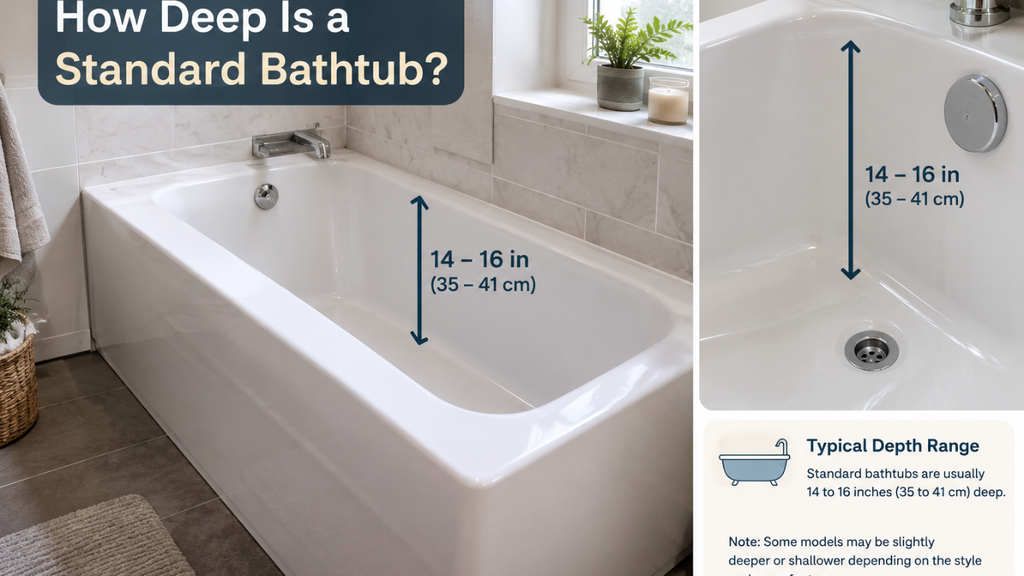
Bathtub depth varies significantly between models, so there is no single depth that applies to every standard bath.
Some conventional baths have an overall height of around 500–550mm, while the actual internal bathing depth is smaller. The internal shape, base design and overflow position all affect how much water can be used.
For this reason, do not compare baths using external height alone. If bathing depth is important to you, check the manufacturer’s technical specification for the actual internal measurements.
Water capacity also varies considerably. For example, current UK bath specifications show different capacities for baths with similar external dimensions because their internal shapes and profiles are different.
Single-Ended vs Double-Ended Bathtubs
Two of the most common bathtub styles are single-ended and double-ended baths.
Single-Ended Bath
A single-ended bath generally has one sloping end for reclining, while the opposite end is used for taps and the waste.
This arrangement is practical for many standard bathroom layouts and is particularly useful when the bath is also going to be used with a shower.
Double-Ended Bath
A double-ended bath normally has sloping ends at both sides, with the tap and waste arrangement positioned more centrally.
This can create a balanced appearance and allows the user to recline at either end. Current UK bath ranges include double-ended models in sizes such as 1600 × 700mm, 1700 × 700mm, 1700 × 750mm, 1700 × 800mm and 1800 × 800mm.
What Is the Best Bathtub Size for a Small Bathroom?
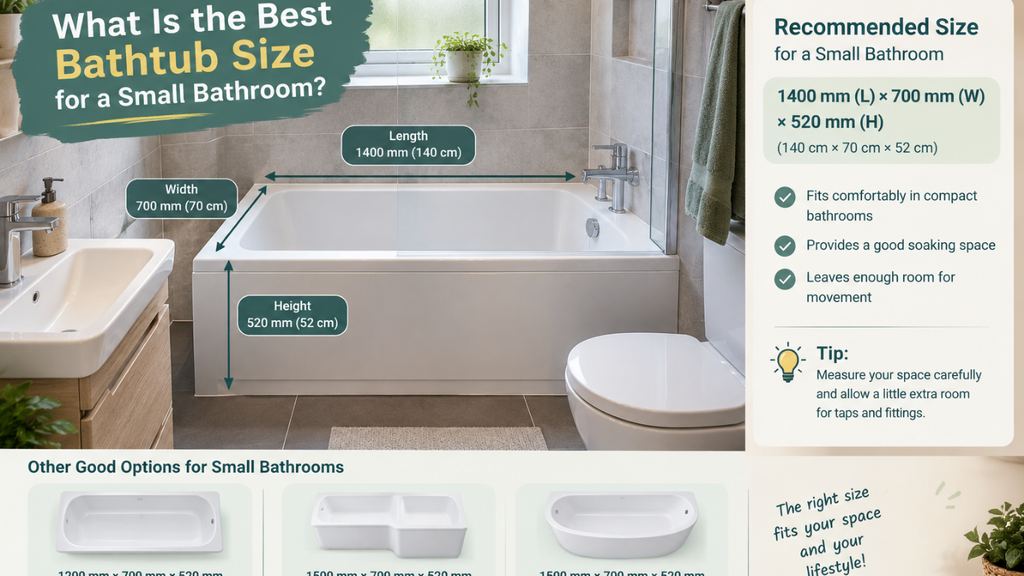
For a small bathroom, choosing a shorter bath can make a significant difference.
A 1500 × 700mm or 1600 × 700mm model can provide a practical alternative when a 1700mm bath is too long. Some manufacturers and retailers also offer 1400mm and even 1200mm options for particularly compact layouts.
When choosing a bath for a small bathroom, consider the complete layout rather than the bath alone.
Check:
- The available wall length
- The width of the bath
- Toilet position
- Washbasin position
- Bathroom door swing
- Shower-screen requirements
- Plumbing locations
- Space needed to enter and leave the bath
A smaller bath is not always automatically better. The aim is to achieve a comfortable layout while keeping enough usable space around the other fixtures.
What Bathtub Size Is Best for a Family Bathroom?
A 1700 × 700mm bath is a practical starting point for many family bathrooms.
If the room allows additional width, a 1700 × 750mm or 1700 × 800mm bath can provide a roomier bathing area. Larger bathrooms may also accommodate an 1800 × 800mm model. These sizes are currently represented across UK bathroom product ranges.
Families who need both bathing and showering may also consider a shower bath. These designs can provide bathing space while creating a wider standing area for showering.
Does Bathtub Shape Affect the Size?
Yes. Two baths with the same external dimensions can have noticeably different internal bathing areas.
Straight rectangular baths usually provide predictable measurements and are easy to position against a wall. P-shaped and L-shaped shower baths have a wider section designed for showering. Freestanding baths can have curved or oval profiles that require more surrounding floor space.
Therefore, always look at the manufacturer’s technical drawing rather than selecting a bath based only on its advertised length.
Common Mistakes When Measuring for a Bath
One of the most common mistakes is measuring the room but not checking the exact product dimensions.
Avoid these errors:
Ignoring the bath width: A 1700mm-long bath may fit perfectly along the wall but still be too wide for the planned layout.
Forgetting the bath panel: The finished installation can occupy more space than the bath shell itself.
Not checking the frame or legs: These can affect the final installed height.
Ignoring plumbing: The waste and overflow positions can affect installation.
Choosing based only on external measurements: Internal bathing space can vary between models.
Forgetting access: Check how the bath will be transported into the bathroom.
How to Choose the Right Bathtub Dimensions in 2026
Start by measuring the available space accurately. Then decide how you will use the bathtub.
If space is limited, consider 1400mm, 1500mm or 1600mm lengths. If you have a conventional family bathroom, 1700 × 700mm is a useful standard size to compare against.
For additional comfort, consider a 1700 × 750mm or 1700 × 800mm bath where the room allows it. For larger bathrooms, an 1800 × 800mm model can provide more bathing space.
The most important point is to compare the complete dimensions, not simply the length advertised in the product title.
Frequently Asked Questions
What is the standard bathtub dimensions UK?
The most common standard reference is 1700 × 700mm, although many other sizes are available in the UK.
Is 1700 × 700mm a standard bath size?
Yes. 1700 × 700mm is one of the most widely available standard bath sizes in the UK.
What is the smallest common bathtub size?
Compact UK baths can be around 1200mm or 1400mm long, although 1500mm models are also a common compact choice. Availability depends on the manufacturer and bath design.
Is a 1600mm bath big enough?
A 1600mm bath can be a practical choice for a smaller bathroom or where a 1700mm bath does not fit. Comfort depends on the user’s height and the bath’s internal shape.
What is the standard bathtub width in the UK?
700mm is a very common width for standard straight baths. Wider options such as 750mm and 800mm are also widely available.
What size bath is best for a small bathroom?
A 1500 × 700mm or 1600 × 700mm bath can be a practical choice when space is limited. Smaller options are available where the room requires them.
Are all 1700mm baths the same size?
No. A 1700mm bath can have different widths, heights, internal shapes, capacities and installation requirements. Always check the individual manufacturer’s dimensions.
Final Thoughts
Understanding standard bathtub dimensions UK makes choosing a new bath much easier. The 1700 × 700mm size remains one of the most common options, but it is only one part of the available range. Shorter 1500mm and 1600mm baths can work well in compact bathrooms, while wider 750mm and 800mm models can provide additional comfort where space allows.
Before buying a bathtub in 2026, measure the available length and width carefully, check the finished height, review the internal dimensions and confirm the plumbing arrangement. Most importantly, use the manufacturer’s technical drawing to verify the exact measurements.
A correctly measured bathtub will not only fit the room more effectively but can also make the entire bathroom more comfortable, practical and easier to use.