
If you are searching for “How Big Is a Double Bedroom UK”, you may want to know how much space a typical double bedroom needs, what size feels comfortable, and how to measure your room correctly. In 2026, double bedrooms across the UK can vary considerably depending on the property type, age, layout and design.
As a practical guide, a double bedroom measuring around 12–14 square metres can provide a comfortable balance between a double bed, wardrobe, bedside tables and walking space. Bedrooms around 14–16 square metres can offer even more flexibility, while rooms around 10 square metres are generally more compact.
It is important to remember that a practical bedroom size and a legal minimum are not always the same thing. Different standards can apply depending on the property and its circumstances.
Quick Guide: Double Bedroom Sizes UK 2026
| Double Bedroom Type | Approx. Size | Approx. Square Feet | Description |
|---|---|---|---|
| Compact Double | 10–12 m² | 108–129 sq ft | Small but usable |
| Standard Double | 12–14 m² | 129–151 sq ft | Comfortable everyday size |
| Spacious Double | 14–16 m² | 151–172 sq ft | Generous furniture space |
| Large Double | 16–20+ m² | 172–215+ sq ft | Very spacious |
| Two-Bedspace Reference | 11.5 m² | 124 sq ft | England standard where applicable |
| HMO Two-Person Minimum | 10.22 m² | 110 sq ft | Specific HMO requirement in England |
These figures should be treated as different reference points rather than one universal UK bedroom rule.
What Is a Standard Double Bedroom Size in the UK?
A standard double bedroom should provide enough space for a double bed, storage and reasonable movement around the room.
For practical planning, 12–14 m² is a useful range.
For example, a room measuring:
3 metres × 4 metres = 12 m²
has approximately 129 square feet of floor area. This can provide enough room for a double bed, bedside tables and a wardrobe when the layout is planned efficiently.
A slightly larger bedroom measuring:
3.2 metres × 4 metres = 12.8 m²
gives additional space for furniture and movement.
However, floor area is only one part of the picture. A bedroom’s width, length, shape, door position, window placement and storage can significantly affect how spacious it feels.
Is 10 m² Big Enough for a Double Bedroom?
A 10 m² bedroom can accommodate a double bed, but it would normally be considered a compact double bedroom.
For example:
2.5 metres × 4 metres = 10 m²
A room of this size may accommodate:
- A double bed
- Small bedside tables
- A compact wardrobe
- A small chest of drawers
The main challenge is additional furniture. If you add a large wardrobe, desk, dressing table and several storage units, the available walking space can become limited.
For this reason, 10 m² can work, but 12 m² or more is generally easier to furnish comfortably.
Is 11.5 m² the Legal Minimum for a Double Bedroom?
This is an important point when researching double bedroom sizes.
11.5 m² is not a universal legal minimum for every double bedroom in the UK.
In England, the Nationally Described Space Standard uses 11.5 m² as the minimum floor area for a double or twin bedroom providing two bedspaces where that standard applies.
It also includes minimum width requirements for double and twin bedrooms.
This should not be interpreted as meaning that every existing double bedroom across the UK must measure at least 11.5 m². The standard is relevant to particular new-dwelling and planning situations.
Therefore, when researching bedroom sizes, it is important to distinguish between:
- Practical bedroom sizes
- New-build standards
- HMO requirements
- Existing homes
- Individual property layouts
Double Bedroom Size for HMO Properties
Certain Houses in Multiple Occupation have specific bedroom requirements.
For applicable licensed HMOs in England, a sleeping room occupied by two people over the age of 10 has a minimum floor area of 10.22 m².
Other minimum requirements apply depending on the number and age of occupants.
The HMO minimum is a regulatory requirement for relevant properties rather than a recommendation for an ideal or spacious bedroom.
This means that a bedroom measuring 10.22 m² may meet a particular minimum requirement while still feeling considerably more compact than a 14 or 16 m² bedroom.
Local requirements can also affect the standards applied to individual HMO properties.
Quick Measure: How to Calculate Double Bedroom Size
Measuring your bedroom is simple.
Use this formula:
Length × Width = Floor Area
For example:
3 m × 4 m = 12 m²
To convert square metres to approximately square feet, multiply the area by 10.764.
For example:
12 × 10.764 = approximately 129 sq ft
Quick Measure Chart
| Length | Width | Floor Area | Approx. Sq Ft |
|---|---|---|---|
| 2.5 m | 4 m | 10 m² | 108 sq ft |
| 2.75 m | 4 m | 11 m² | 118 sq ft |
| 2.75 m | 4.2 m | 11.55 m² | 124 sq ft |
| 3 m | 4 m | 12 m² | 129 sq ft |
| 3.2 m | 4 m | 12.8 m² | 138 sq ft |
| 3.5 m | 4 m | 14 m² | 151 sq ft |
| 4 m | 4 m | 16 m² | 172 sq ft |
If the room has an unusual shape, divide it into smaller rectangular sections and calculate each section separately.
For example:
3 m × 3 m = 9 m²
and:
1 m × 2 m = 2 m²
Total:
9 + 2 = 11 m²
This method gives a more accurate measurement for irregular bedrooms.
Why Bedroom Width Matters
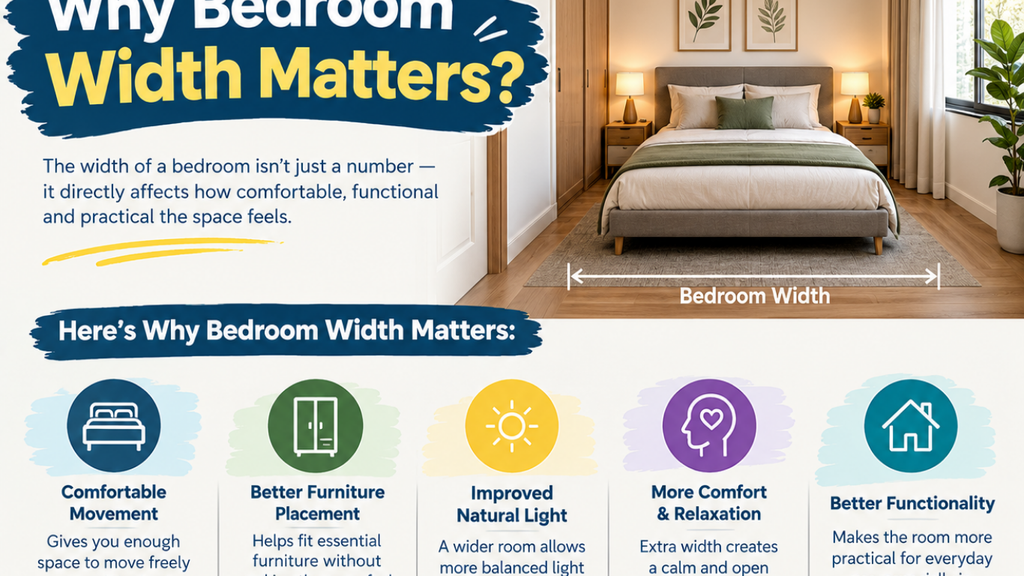
The total floor area does not tell you everything about a bedroom.
Two rooms can both measure 12 m² but have completely different layouts.
For example, a room measuring 3 m × 4 m has a relatively practical shape. A narrow bedroom could also contain 12 m² but make furniture placement more difficult.
Width is especially important because a double bed occupies a significant amount of floor space. You need enough room around it to walk comfortably and access wardrobes and drawers.
A well-proportioned bedroom can therefore feel much larger than a narrow room with exactly the same floor area.
What Furniture Fits in a Double Bedroom?
The furniture that can comfortably fit depends on the bedroom’s size and shape.
Compact Double: 10–12 m²
A compact bedroom may be best suited to:
- Double bed
- Small bedside tables
- Compact wardrobe
- Small chest of drawers
Standard Double: 12–14 m²
A standard bedroom can usually provide more flexibility for:
- Double bed
- Two bedside tables
- Full-size wardrobe
- Chest of drawers
- Small desk or dressing table
Spacious Double: 14–16 m²
A spacious bedroom may allow:
- Double or larger bed
- Larger wardrobe
- Two bedside tables
- Chest of drawers
- Dressing table
- Small desk or reading area
The actual arrangement will depend on windows, doors, radiators and built-in storage.
What Is a Comfortable Double Bedroom Size?
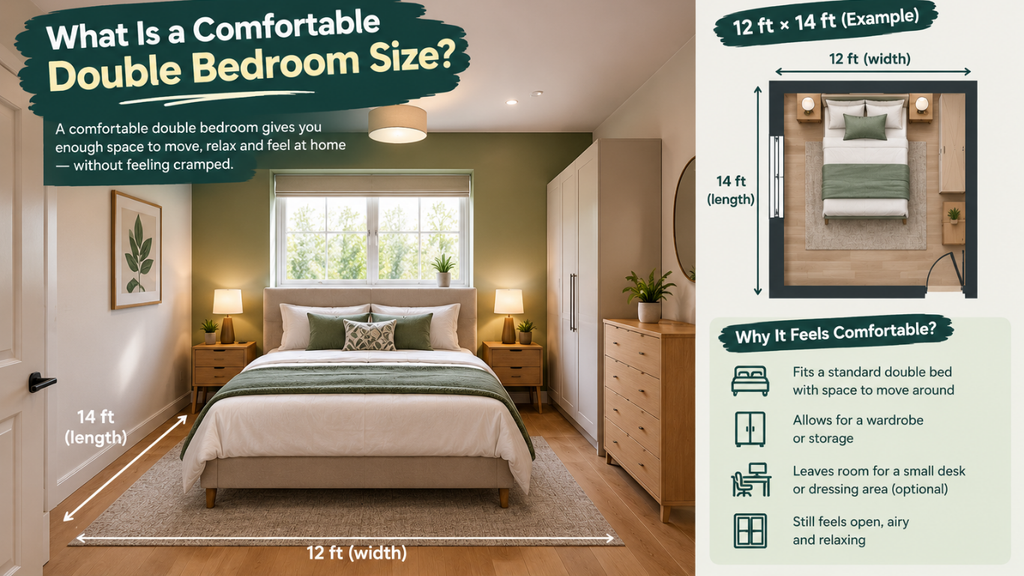
For practical everyday use, 12–14 m² is a useful comfortable range.
A 12 m² bedroom can provide enough space for essential furniture when the room has an efficient layout.
A 14 m² bedroom provides more flexibility and can accommodate additional furniture without making the room feel as crowded.
Bedrooms measuring 16 m² or more can feel considerably more spacious and may allow additional furniture or storage.
These ranges are practical guidelines rather than universal legal requirements.
How Room Shape Affects Bedroom Size
Room shape can make a significant difference.
Consider two bedrooms that both have an area of 12 m².
One could measure:
3 m × 4 m
while another might be considerably narrower and longer.
Although the floor area is identical, the first room may be easier to furnish because the bed and wardrobes can be arranged more efficiently.
Irregular corners, chimney breasts, sloping ceilings and awkward door positions can also reduce usable space.
When viewing a property, therefore, look at the actual dimensions rather than relying only on the description “double bedroom.”
Does Ceiling Height Matter?
Yes. Ceiling height can influence how spacious a bedroom feels.
A room with a generous ceiling can feel more open, while a bedroom with a low or heavily sloping ceiling can have less usable space.
This is especially important for loft bedrooms and rooms built into roof spaces.
When measuring a bedroom, consider not only the floor dimensions but also whether parts of the room have restricted headroom.
A room may have a reasonable floor area but offer less practical space if large sections have low ceilings.
How to Make a Small Double Bedroom Feel Bigger
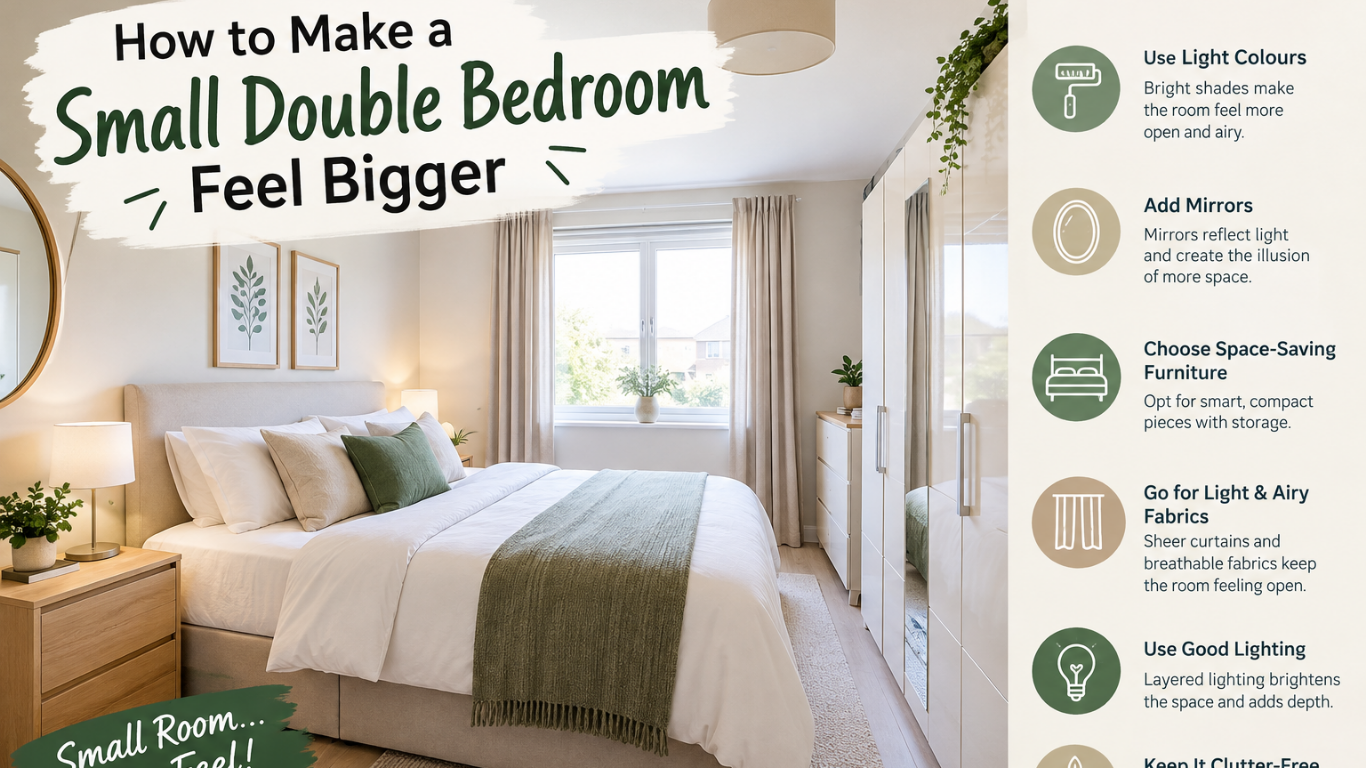
A small double bedroom can still look comfortable with careful planning.
Start by choosing furniture that is proportional to the room. Oversized wardrobes and large cabinets can quickly consume valuable floor space.
Under-bed storage is useful because it provides additional storage without requiring another large piece of furniture.
Tall wardrobes can also make better use of vertical space.
Keep the main walking route clear around the bed and avoid placing unnecessary furniture in corners.
Natural light can also make a compact bedroom feel more open. Mirrors, simple furniture and lighter interior finishes can create a brighter appearance.
The goal is not simply to make the room look empty but to use the available space efficiently.
Double Bedroom Measurement Examples
Here are some simple examples you can use when comparing bedroom dimensions:
2.5 m × 4 m = 10 m²
A compact double bedroom.
2.75 m × 4 m = 11 m²
Still relatively compact.
2.75 m × 4.2 m = 11.55 m²
Approximately 124 square feet.
3 m × 4 m = 12 m²
A practical standard double bedroom.
3.2 m × 4 m = 12.8 m²
A comfortable and flexible size.
3.5 m × 4 m = 14 m²
A spacious double bedroom.
4 m × 4 m = 16 m²
A large and generous bedroom.
These examples make it easier to understand how small changes in length and width affect the overall room size.
How Big Should a Double Bedroom Be for Two People?
A double bedroom designed for two people needs enough space not only for the bed but also for clothing, storage and everyday movement.
A 10 m² room can accommodate a double bed, but two people’s belongings may make it feel crowded.
A bedroom around 12–14 m² provides a more practical balance.
If you want larger wardrobes, additional furniture or a more spacious layout, 14–16 m² or more can provide greater flexibility.
The room’s shape remains important. A well-designed 12 m² bedroom can be more practical than a poorly shaped larger room.
What to Check When Measuring a Double Bedroom
If you are buying or renting a property, take measurements rather than relying only on the estate-agent description.
Check:
- Length
- Width
- Ceiling height
- Door position
- Window position
- Wardrobe location
- Bed placement
- Walking space
- Radiator position
- Built-in storage
Also consider how your existing furniture will fit.
A bedroom may technically be large enough for a double bed but still have limited usable space because of the position of doors, windows or built-in cupboards.
Double Bedroom vs Master Bedroom
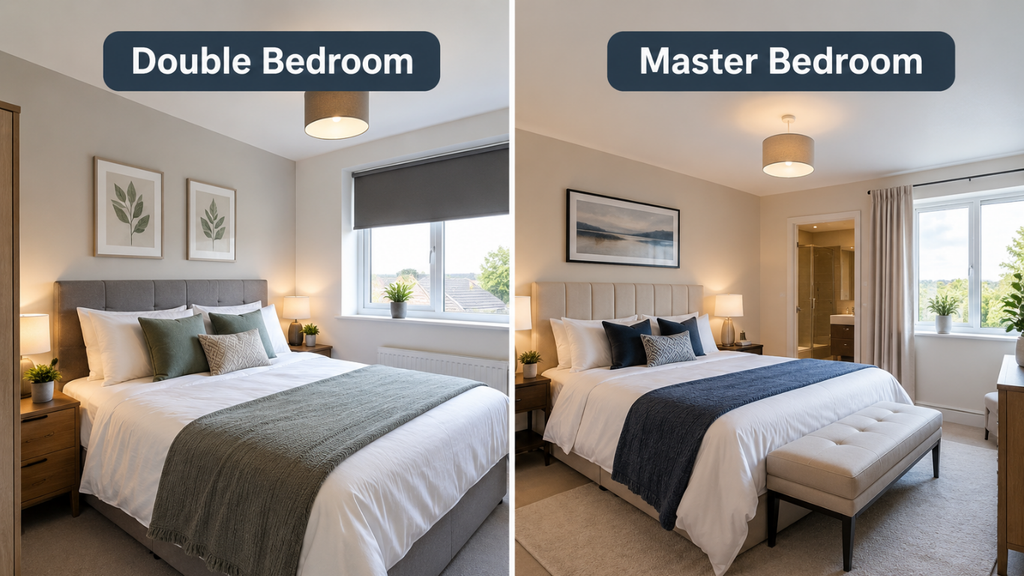
A double bedroom does not automatically mean it is a master bedroom.
A double bedroom simply indicates that the room is intended to accommodate a double bed or two people.
A master bedroom is usually the principal bedroom in a property and may be larger or have additional features such as an ensuite bathroom or greater storage.
A standard double bedroom can therefore be 12 m², while a master bedroom may be 16 m², 18 m² or considerably larger.
There is no single fixed size that automatically changes a double bedroom into a master bedroom.
Final Answer: How Big Is a Double Bedroom UK?
So, how big is a double bedroom UK in 2026?
There is no single size that applies to every double bedroom throughout the UK.
As a practical guide:
- 10–12 m²: Compact double
- 12–14 m²: Comfortable standard double
- 14–16 m²: Spacious double
- 16–20+ m²: Large double bedroom
For practical everyday living, 12–14 m² is a useful target because it can provide enough room for a double bed, storage and reasonable movement.
A bedroom measuring 14–16 m² offers more flexibility for larger furniture and additional storage.
The 11.5 m² figure associated with England’s two-bedspace space standard and the 10.22 m² HMO minimum have specific contexts and should not be treated as one universal UK-wide bedroom requirement.
Ultimately, the best double bedroom is not determined by floor area alone. Width, room shape, ceiling height, furniture placement, storage and walking space all influence how comfortable the room feels.
FAQs About Double Bedroom Size UK
1. What is a normal double bedroom size in the UK?
A practical double bedroom commonly falls around 12–14 m², although actual sizes vary significantly between properties.
2. Is 10 m² enough for a double bedroom?
Yes. A double bed can fit in a 10 m² room, but the room will generally feel compact and furniture will need to be planned carefully.
3. Is 12 m² a good double bedroom size?
Yes. 12 m² can provide a comfortable and practical bedroom when the room has a sensible shape and furniture layout.
4. Is 14 m² a large double bedroom?
A 14 m² bedroom can be considered spacious for a typical double bedroom and provides more flexibility for storage and furniture.
5. What is the minimum HMO double bedroom size in England?
For applicable licensed HMOs, the minimum sleeping-room floor area for two people over 10 is 10.22 m². This is an HMO-specific requirement and should not be treated as the standard size for every double bedroom.
Read More https://ukwordle.co.uk/wp-admin/post.php?post=162&action=edit