
When planning, buying, renting, renovating, or converting a bedroom, one of the most important questions is:what is the minimum bedroom size in the UK? The answer is not as simple as one fixed measurement because bedroom-size rules depend on the type of property, how many people will use the room, and which part of the UK the property is located in.
In 2026, the clearest statutory minimum bedroom measurements apply particularly to licensed Houses in Multiple Occupation (HMOs) in England. For a standard bedroom in an ordinary owner-occupied or single-household home, there is not one universal UK-wide rule saying every bedroom must be a particular number of square metres.
This complete guide explains the Minimum Bedroom Size UK requirements, useful measurements, HMO rules, practical bedroom dimensions, and how to calculate floor area correctly.
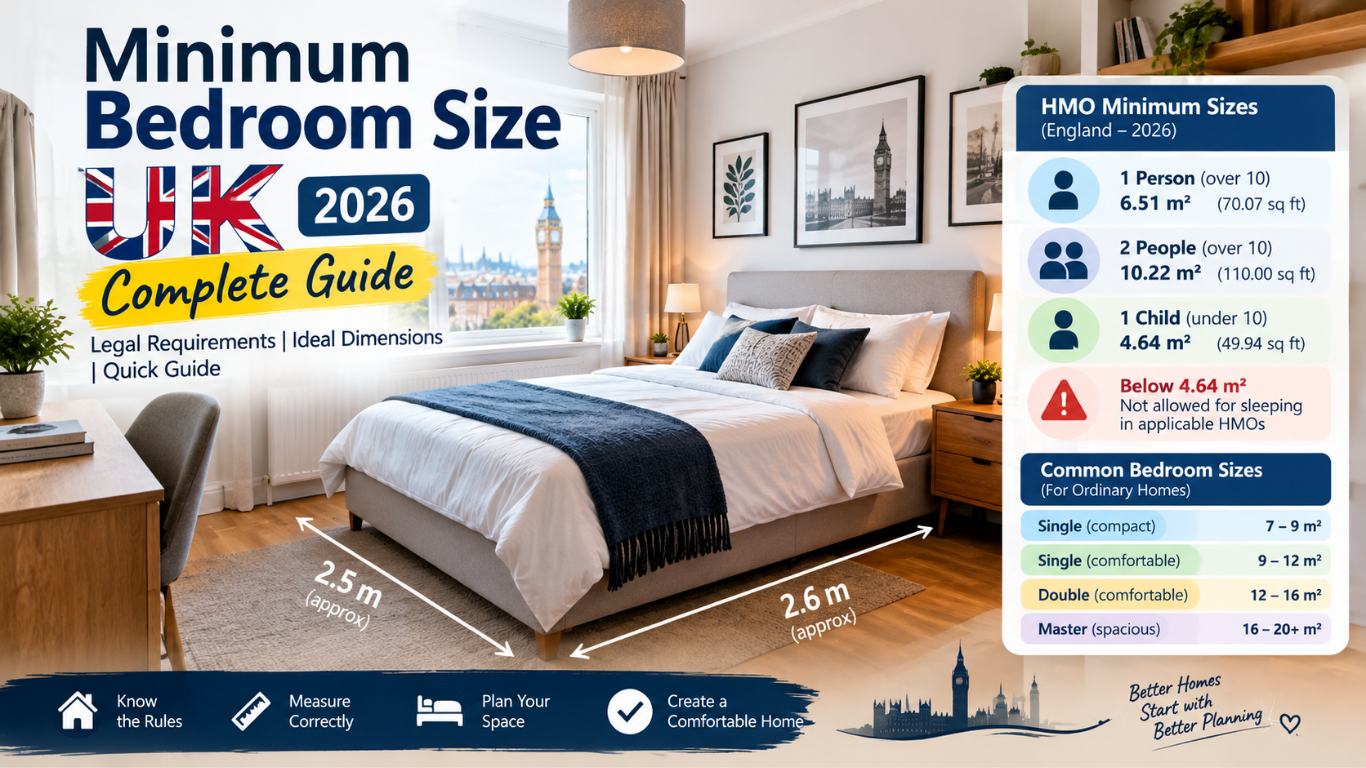
Quick Guide: Minimum Bedroom Size UK 2026
| Bedroom Type / Use | Minimum or Common Measurement | Approx. Square Feet |
|---|---|---|
| HMO bedroom for 1 person aged over 10 | 6.51 m² | 70.07 sq ft |
| HMO bedroom for 2 people aged over 10 | 10.22 m² | 110.00 sq ft |
| HMO bedroom for 1 child under 10 | 4.64 m² | 49.94 sq ft |
| Room below HMO sleeping minimum | Under 4.64 m² | Under 49.94 sq ft |
| Practical compact single bedroom | Around 7–9 m² | Around 75–97 sq ft |
| Comfortable single bedroom | Around 9–12 m² | Around 97–129 sq ft |
| Comfortable double bedroom | Around 12–16 m² | Around 129–172 sq ft |
| Spacious master bedroom | Around 16–20+ m² | Around 172–215+ sq ft |
Important: The figures of 6.51 m², 10.22 m² and 4.64 m² are statutory minimum sleeping-room standards for applicable licensed HMOs in England. They should not automatically be treated as the ideal size for an ordinary bedroom.
What Is the Legal Minimum Bedroom Size in the UK?
There is an important difference between a legal minimum and a comfortable or recommended bedroom size.
For ordinary homes occupied by one household, there is no single UK-wide rule that says every bedroom must be at least 6.51 m². The rules can depend on planning, building regulations, housing standards, overcrowding rules, property type and local requirements.
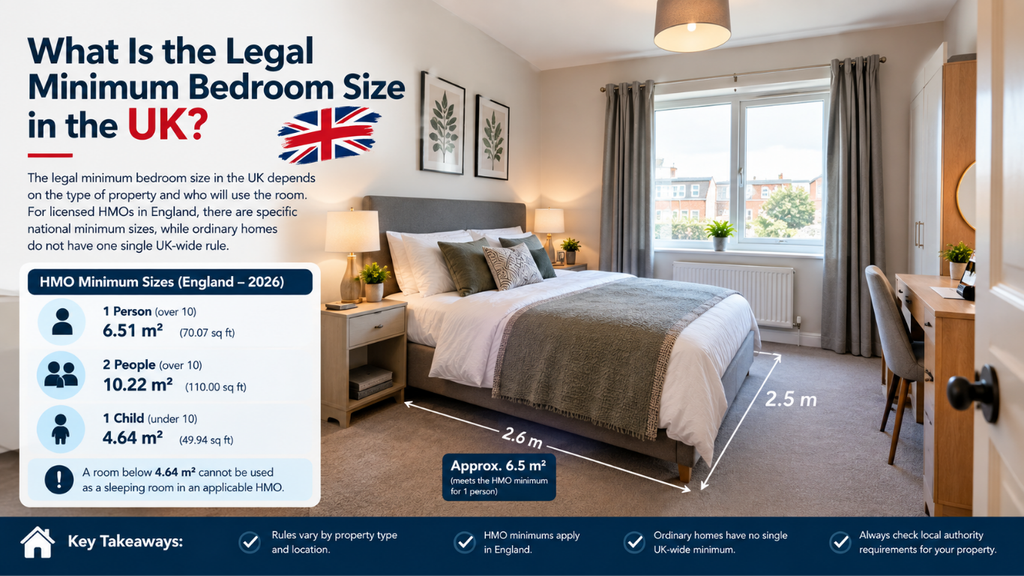
For licensed HMOs in England, national minimum sleeping-room sizes apply. A room used by one person aged over 10 must generally have at least 6.51 square metres of floor area. A room occupied by two people aged over 10 must generally have at least 10.22 square metres.
For one child under 10, the minimum is 4.64 square metres.
A room below 4.64 m² cannot be used as sleeping accommodation in an applicable licensed HMO.
These figures are statutory minimums rather than targets for comfortable bedroom design.
6.51 m²: The Key Single-Bedroom HMO Minimum
If you are researching Minimum Bedroom Size UK because of an HMO, the figure you will most commonly see is 6.51 m².
This is the national minimum floor area for a sleeping room occupied by one person aged over 10 in a licensed HMO in England.
To understand the measurement, 6.51 m² is approximately:
2.55 m × 2.55 m = 6.50 m²
or approximately:
2.50 m × 2.60 m = 6.50 m²
These dimensions demonstrate that a room can technically reach the minimum without being particularly spacious.
Once you add a bed, wardrobe, desk, chair and other furniture, a bedroom of this size can feel quite compact. This is why the statutory minimum should not be confused with a comfortable bedroom size.
10.22 m²: Minimum for Two Adults in an HMO
For two people aged over 10 sharing a sleeping room in a licensed HMO in England, the national minimum is 10.22 m².
For example:
3.20 m × 3.20 m = 10.24 m²
This is very close to the required area.
Another possible layout could be approximately:
2.90 m × 3.52 m = 10.21 m²
The exact shape can vary, but the total usable floor area is important.
A 10.22 m² bedroom can accommodate a double bed and basic furniture, but the amount of free movement space will depend heavily on the room’s shape, doors, windows, radiator position and built-in storage.
4.64 m²: Minimum for a Child Under 10
For applicable licensed HMOs in England, the minimum sleeping-room floor area for one child under 10 is 4.64 m².
For example:
2.00 m × 2.32 m = 4.64 m²
This is a very small room, so although it meets the specific statutory measurement for a child in an applicable HMO, it should not be interpreted as a generally desirable bedroom size.
Any applicable HMO room measuring less than 4.64 m² cannot be used as sleeping accommodation.
How Is Bedroom Floor Area Measured?
When calculating HMO sleeping-room size, the measurement is based on the usable floor area.
One particularly important point is ceiling height. Floor space where the ceiling is below 1.5 metres is generally excluded from the calculation for these HMO minimum room-size requirements.
This matters especially in:
- Loft bedrooms
- Attic rooms
- Rooms with sloping ceilings
- Converted roof spaces
- Bedrooms with low eaves
For example, a loft bedroom might appear large when measured across the entire floor, but if substantial parts of the room have a ceiling below 1.5 metres, those areas may not count toward the required floor area.
Quick Measurement Chart
Use this simple calculation when checking a rectangular bedroom:
Length × Width = Floor Area
| Length | Width | Approx. Area |
|---|---|---|
| 2.0 m | 2.32 m | 4.64 m² |
| 2.5 m | 2.60 m | 6.50 m² |
| 2.55 m | 2.55 m | 6.50 m² |
| 2.8 m | 3.0 m | 8.40 m² |
| 3.0 m | 3.0 m | 9.00 m² |
| 3.2 m | 3.2 m | 10.24 m² |
| 3.0 m | 4.0 m | 12.00 m² |
| 3.5 m | 4.0 m | 14.00 m² |
These examples are useful for understanding dimensions, but they do not replace checking the requirements that apply to a specific property.
What Is a Good Bedroom Size?
A bedroom can meet a minimum requirement and still feel uncomfortable. For everyday residential design, many people prefer more space than the statutory HMO minimum.
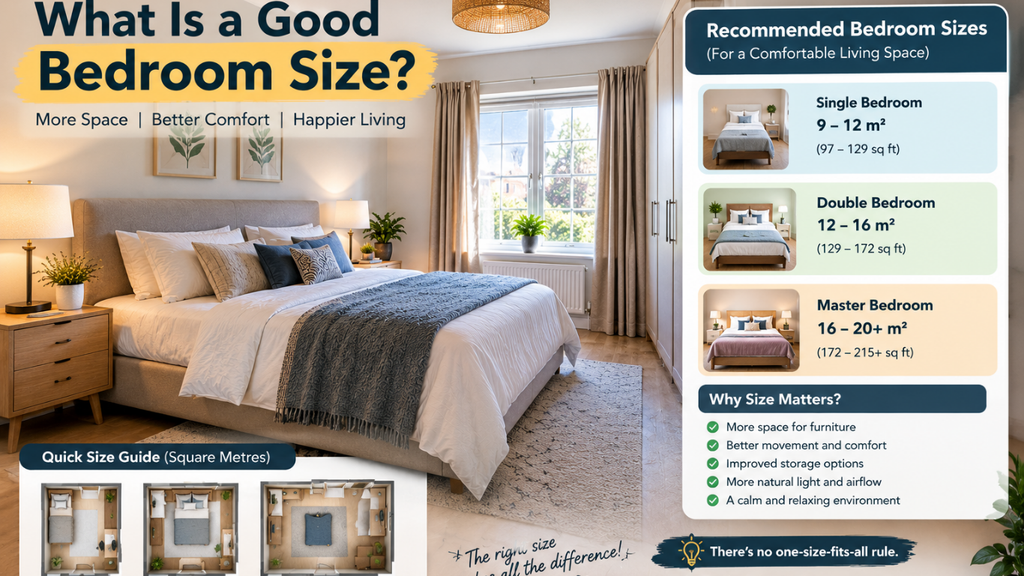
A single bedroom of around 9–12 m² can provide considerably more flexibility for a single bed, wardrobe, storage and a small desk.
A double bedroom around 12–16 m² generally provides more practical furniture-placement options.
A master bedroom around 16–20 m² or more can accommodate larger furniture, additional storage or a seating area, depending on its shape.
These are practical size ranges rather than universal legal requirements.
Minimum Bedroom Size for a Double Bedroom
There is no single UK-wide legal bedroom dimension that automatically applies to every ordinary double bedroom.
For an applicable licensed HMO in England, however, the national minimum for two people aged over 10 is 10.22 m².
For a normal family home, the actual bedroom size can be larger or smaller depending on the property’s design and the regulations relevant to that project.
For comfort, a double bedroom of around 12 m² or more can offer substantially more flexibility than a room close to the HMO statutory minimum.
Does a Bedroom Have to Be a Certain Width?
Minimum bedroom requirements are generally concerned with floor area and suitability, rather than simply requiring one universal width.
A room could technically have the required total area but still have an awkward shape that makes it difficult to use effectively.
For example, a long, narrow room might have the same floor area as a square room but provide less convenient space for a bed, wardrobe and circulation.
When designing a bedroom, consider:
- Bed position
- Door swing
- Window location
- Wardrobe depth
- Storage
- Radiators
- Walking space
- Natural light
- Ventilation
- Ceiling height
The usable layout is often just as important as the total number of square metres.
Minimum Bedroom Size UK: HMO vs Ordinary Home
This distinction is essential.
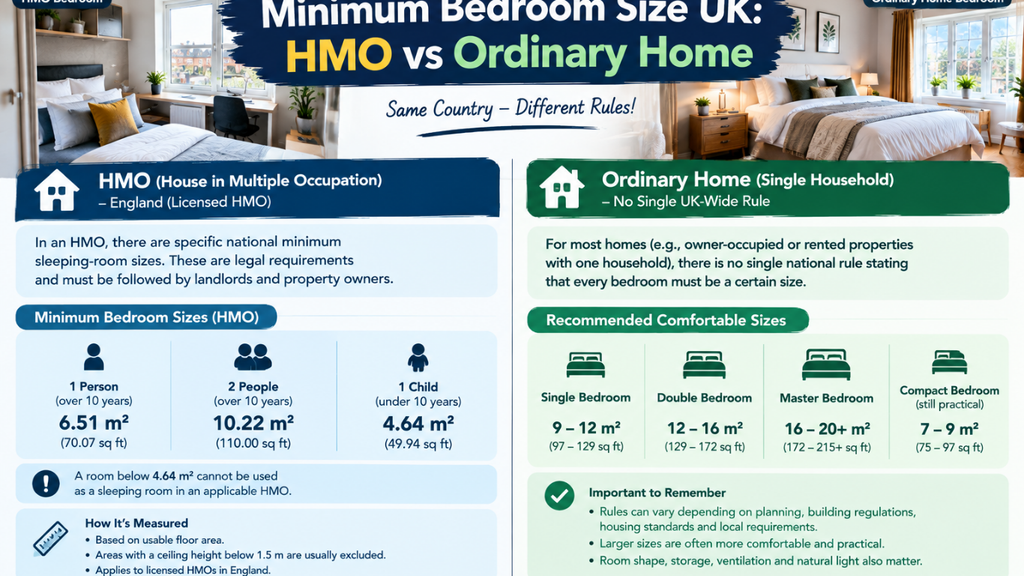
Licensed HMO in England: Specific national minimum sleeping-room sizes apply.
Ordinary single-household home: There is no single national rule stating that every bedroom must be 6.51 m².
Loft bedroom: Low-ceiling areas may affect the usable floor-area calculation, particularly for HMO standards.
Two-person HMO bedroom: The national minimum is 10.22 m² for two people aged over 10.
Child’s HMO bedroom: The specific minimum is 4.64 m² for one child under 10.
Local authorities can also have additional standards or requirements in particular circumstances, so a property owner should check the rules applicable to the property rather than assuming one measurement applies everywhere.
Does the UK Have One Bedroom Size Rule?
No. The phrase “Minimum Bedroom Size UK” can be misleading because housing regulation is not identical across the entire United Kingdom.
England, Scotland, Wales and Northern Ireland have their own housing and regulatory frameworks. In England, the 6.51 m², 10.22 m² and 4.64 m² figures are particularly relevant to licensed HMOs.
Therefore, anyone planning an HMO, conversion, rental property or new development should establish the jurisdiction and property type before relying on a particular minimum.
Final Thoughts
The Minimum Bedroom Size UK depends on what kind of property you are dealing with. For licensed HMOs in England, the key national minimums in 2026 are 6.51 m² for one person aged over 10, 10.22 m² for two people aged over 10, and 4.64 m² for one child under 10.
However, these are statutory minimum sleeping-room standards for applicable HMOs, not recommendations for comfortable everyday bedroom design. A bedroom that is legally large enough may still feel cramped once a bed, wardrobe, desk and other furniture are installed.
For a practical home design, looking beyond the legal minimum is usually important. Room shape, ceiling height, storage, furniture placement, ventilation, lighting and available circulation space can all influence how useful a bedroom feels.
In 2026, anyone checking a bedroom’s compliance should therefore consider the property’s location, whether it is an HMO, the number and age of occupants, usable floor area and any applicable local standards rather than relying on a single UK-wide number.
Read More https://ukwordle.co.uk/wp-admin/post.php?post=154&action=edit